
Site Selection
How a Three-Company Biopharma Cluster Formed in Houston
September 23, 2026
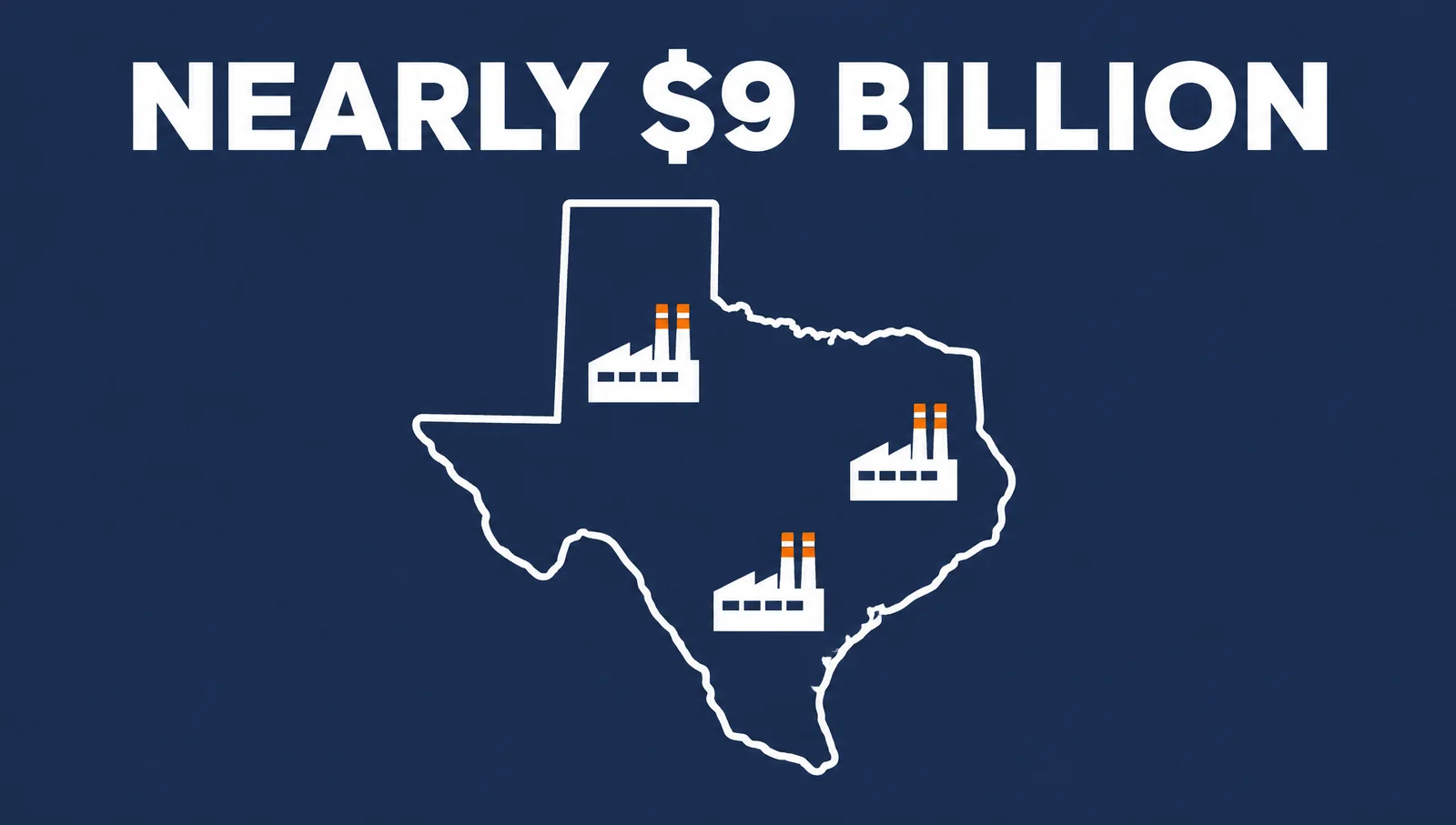
Eli Lilly broke ground on September 21, 2026, on a $6.5 billion pharmaceutical plant in Generation Park, in northeast Houston. It's the largest active pharmaceutical ingredient manufacturing investment in Texas history, and the state extended a $5.5 million grant from the Texas Enterprise Fund. The project was also approved separately under the Jobs, Energy, Technology, and Innovation (JETI) program, which limits school district property taxes on the plant for 10 years. The groundbreaking landed exactly one year after Lilly first announced the project.
It's not the only company that picked this corner of Harris County. Bristol Myers Squibb committed $2.3 billion to a manufacturing campus at the same site in August 2026, backed by a $4.89 million state grant. United Therapeutics announced its own project first, in January 2025: a $96 million facility to breed genetically modified pigs for human organ transplants, with construction beginning roughly a year later. Three companies, three unrelated products, one address.
That's a cluster forming, and it's worth understanding why it happens, because it's rarely an accident. Once a handful of companies in the same field establish themselves near each other, each new arrival finds something the first one didn't have: workers who already understand the manufacturing process, suppliers who are already local, contractors and regulators who have already been through the permitting and inspection process once. The cost of locating the second company drops because of the first. The cost of the third drops further. Houston has lived through this exact pattern before, in energy, where oil majors, service companies, and engineering firms sit within a few miles of each other for the same reason. It's living through it again now, in medicine.
Part of why it's happening in this specific location sits about thirty minutes away by car: the Texas Medical Center, the largest medical complex in the world. TMC houses 21 hospitals, employs more than 106,000 people, and handles over 10 million patient visits a year. That density of doctors, researchers, and specialized medical labor is what these three companies are actually buying when they choose to build next door to it, more than any single incentive package could provide on its own.
Texas Enterprise Fund grants and JETI approval matter to a decision like this, but they're rarely the deciding factor by themselves. Since the fund's creation in 2003, the "but for" test has asked whether an incentive is actually what got a company to choose Texas over a competing state, and for a project this size, the honest answer is usually that workforce and infrastructure fundamentals did most of the real work. What the incentive buys the state is a seat at the table while a company is still comparing options that look similarly strong on paper.
None of this happens by luck, and it doesn't happen only because companies decided to show up. Healthcare capacity gets built deliberately, over years, through decisions most people never see. Texas's biennial state budget devotes an entire article, Article II, to health and human services spending: Medicaid, the Children's Health Insurance Program, mental health services, and the state's broader public health system. Biomedical research funding runs mostly through a separate channel: Houston institutions alone pulled in more than $1.25 billion in NIH funding across over 2,200 awards, according to a recent industry ranking that named Houston the top emerging biopharma cluster in the country. Both tracks matter to a region like this.
Workforce planning followed the same forward-looking logic. San Jacinto College opened the only NIBRT-licensed biotechnology training center in the southern United States in September 2025. NIBRT, the National Institute for Bioprocessing Research and Training, licenses a small, selective network of training partners around the world, and San Jacinto College is the exclusive one covering this part of the country. The workforce pipeline for advanced biomanufacturing roles was running before the third company arrived needing trained workers, which is the reverse of how most regions sequence it.
Texas already had the healthcare infrastructure. The manufacturing base is catching up to match it now, and the state's site-selection and incentive apparatus played its part in getting the two working together.
Jacey Jetton, Founder & CEO, Jetton Solutions